Where dimensions, design intent, and acceptance checks can be made explicit, a scoped workflow may create or revise repeatable part features for review.
SOLIDWORKS automation and API development
Turn repeatable CAD work into reviewable operations.
Scope one engineering operation around explicit inputs, controlled actions, and evidence a responsible person can check. Delvaux develops automation around the tools and review practices the work requires.
SOLIDWORKS is a trademark of Dassault Systèmes or its subsidiaries. Delvaux Technologies is independent; the reference identifies the software and does not imply affiliation, certification, partnership, or endorsement.
Start with the repeated work.
Each workflow is conditional on an assessed environment, reviewed inputs, and agreed acceptance criteria.
Where approved templates and drafting rules exist, automation may populate views, annotations, and supporting documentation for a responsible reviewer to check.
Where the environment supports the required formats, a workflow may prepare exports using agreed naming, configuration, destination, and approval rules.
Where units, reference values, and tolerances are defined, API readbacks may support dimension and geometry checks, with discrepancies routed to review.
Where access and API surfaces permit, a scoped integration may exchange approved inputs and results with file stores, job queues, or other engineering systems.
Synthetic example / reviewed reference
A two-hole plate, with the evidence exposed.
An 80 × 40 × 10 mm two-hole mounting plate with two Ø8 mm through-holes illustrates how a bounded job can be specified and reviewed. This is reference evidence, not a demonstration of automatic drawing interpretation or CAD construction.
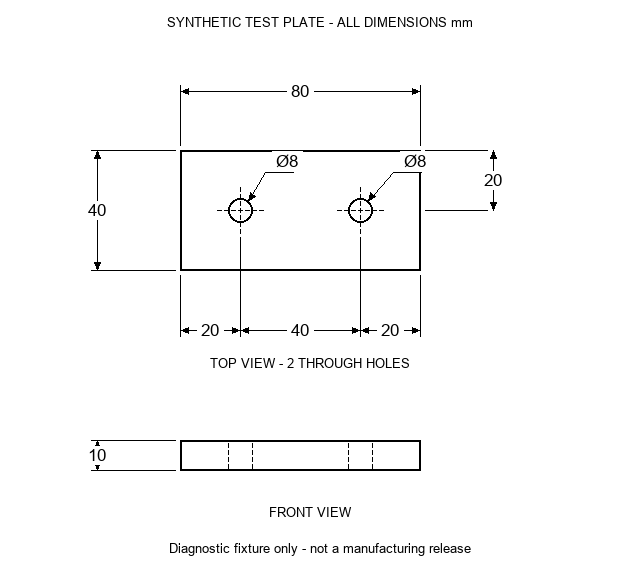
Input
A synthetic dimensioned drawing. Hole centers are (20, 20) and (60, 20) mm, measured from the left-front-bottom plate corner; both holes pass through the 10 mm thickness along Z.
Process
- Review the dimensions and coordinate convention: the length chain is 20 + 40 + 20 = 80 mm and both centers lie on the 20 mm width centerline.
- Agree the intended features and acceptance checks before any scoped CAD operation.
- For an implemented workflow, compare model readbacks against the reviewed dimensions and independent analytic reference, then route discrepancies to human review.
Output
The published outputs here are the synthetic source image and a downloadable evidence manifest containing reviewed dimensions and independent analytic comparison values. No generated SOLIDWORKS or Paramach model is presented as an output.
Review
A responsible reviewer must confirm units, hole locations, through-hole direction, feature intent, and any model readbacks. Analytic values in the manifest are expected references, not measurements from a CAD model.
Limitations
- No material, density, tolerances, manufacturing process, or production suitability is specified.
- The independent STEP reference mentioned in the manifest is comparison evidence only, not a demonstrated product output.
- The example does not establish manufacturability, safety, or readiness for release.
Deliverables with a review path.
Agree what the engagement will produce before building it.
Inputs, intended operations, environment assumptions, exclusions, and acceptance criteria.
The agreed automation or integration, with setup instructions for the assessed environment.
Representative test cases, available execution evidence, exception handling, and reviewer responsibilities. Native files, drawings, exports, and support arrangements are specified per engagement.
Boundaries before release.
Automation does not replace engineering judgment.
Output validity depends on reviewed inputs, the assessed environment, licensing, templates, available API surfaces, and acceptance criteria. Changes to any of these may require revalidation.
The service provides no certification of a model, drawing, manufacture, safety, or regulatory fitness. Manufacturability and release remain subject to the responsible engineering and production review.
03 / Product relationship
A service, and a product direction.
Paramach explores tool-driven CAD workflows. A service engagement starts with your specific operation and acceptance criteria.
A suitable product foundation may be used when its fit is validated. The synthetic evidence above is a review reference and does not establish product readiness.
Define the conditions.
- What does a first engagement need?
- Start with one repeatable operation, representative inputs you can share, the intended result, and the person responsible for acceptance. Discovery establishes the environment, constraints, and a bounded validation plan before implementation.
- Which versions and API surfaces can a workflow use?
- Version, installation, available API surfaces, licensing, permissions, and templates must be checked in the intended environment. Compatibility and deployment scope are agreed for that environment after assessment; this page makes no blanket version claim.
- Can the result go directly to manufacture or release?
- Engineering judgment remains with the responsible people. A scoped workflow can support review, but does not certify a model, drawing, manufacture, safety, or regulatory fitness. Manufacturing acceptance and release require their own checks and approval.
- How does this service relate to Paramach?
- Paramach is a product direction for tool-driven CAD workflows. This service scopes a specific operation in an assessed environment. A project may inform or use a suitable product foundation when validated for the job; product status does not establish readiness for a particular deployment.
Bring one operation.
Describe the repeated work, the intended result, the environment, and who will review it. We can assess a bounded starting point.